
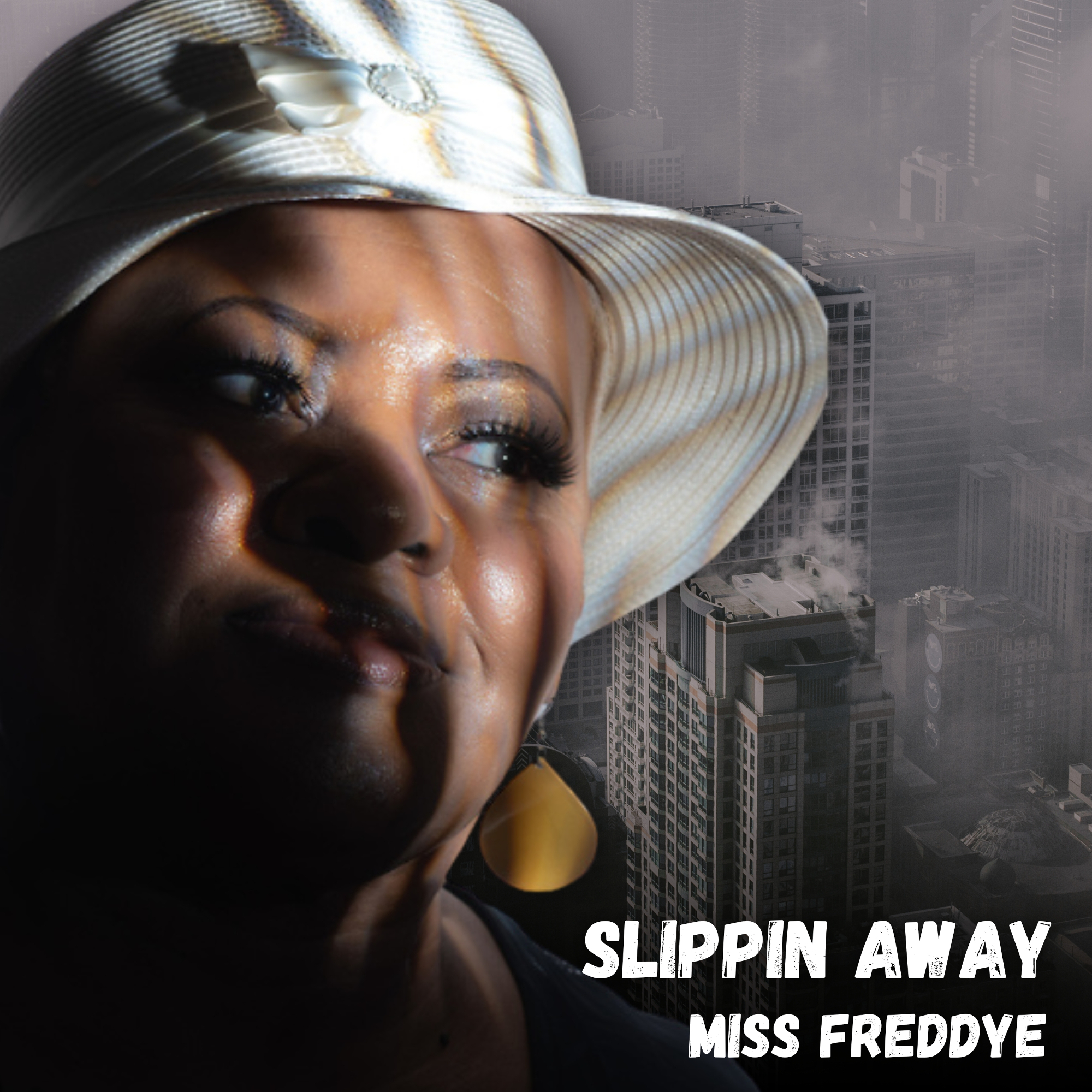
Miss Freddye’s Slippin’ Away Carries the Weight of the Blues Tradition

Miss Freddye has never approached the blues as a stylistic exercise, and Slippin’ Away makes that clear from its opening bars. This is not a performance built on flash or reinterpretation—it’s rooted in the deeper function of the blues as personal testimony. In that sense, the single aligns closely with the classic vocal tradition, where emotional credibility outweighs technical display.
A veteran of the Pittsburgh blues scene, Miss Freddye (Freddye Stover) brings decades of experience shaped by both gospel influence and the practical demands of live performance. That background is evident in her phrasing, which is deliberate and unhurried. She understands how to inhabit a lyric rather than simply deliver it, a quality that distinguishes seasoned blues vocalists from more contemporary interpreters of the form.
The song itself, written by the late Mike Lyzenga, adheres to a familiar thematic structure: the dissolution of a relationship rendered through imagery of loss and inevitability. There are no surprises in the narrative, but that is not a weakness. The blues has always relied on repetition and variation, and Slippin’ Away succeeds because of how it navigates that tradition rather than attempting to escape it.
Musically, the track is restrained. Guitarist Mike Huston provides measured, economical lines that echo the vocal without competing for attention. His phrasing recalls the understated approach of postwar electric blues, where tone and timing take precedence over speed.
Jeff Conner’s keyboard work introduces a subtle gospel undercurrent, reinforcing the song’s emotional gravity without tipping into sentimentality. The rhythm section—Greg Sejko on bass and Bob Dicola on drums—maintains a steady, unobtrusive pulse, allowing the arrangement to remain open and uncluttered.
Miss Freddye’s role as producer is central to the recording’s effectiveness. The mix favors balance and clarity, avoiding the excessive layering that often characterizes modern blues productions. There is a conscious effort to preserve space within the arrangement, which in turn emphasizes the vocal. This approach reflects an understanding of traditional blues recording aesthetics, where immediacy and presence are prioritized over polish.
Vocally, Freddye demonstrates control and nuance. She resists the temptation to oversing, instead allowing the emotional content of the lyric to emerge gradually. When she delivers the line “I feel you slipping through my hands,” the impact comes not from vocal power but from restraint. It is a measured expression of loss, consistent with the blues tradition’s emphasis on understatement.
What Slippin’ Away ultimately reveals is Miss Freddye’s commitment to the core values of the genre: honesty, simplicity, and emotional directness. At a time when blues is frequently hybridized or repackaged for broader audiences, her approach remains grounded in its original intent. This is not revivalism for its own sake, but continuity—an artist working within a tradition and contributing to its ongoing life.
While the single does not seek to innovate structurally or stylistically, it achieves something equally important. It affirms that the essential elements of the blues—voice, story, and feeling—remain sufficient when handled with care and experience. In Slippin’ Away, Miss Freddye offers a recording that is both modest in scope and significant in execution, reinforcing her place within the contemporary blues landscape.
–John Sully